# OTEL forwarding
The **OTEL Forwarding** section sends a copy of every OTEL payload received on the hooks endpoint to an external collector, so the same agent telemetry that powers the [Observe pages](/docs/ai-control-plane/observe) also lands in an existing observability stack. Forwarding is a copy, not a redirect: the platform keeps ingesting and processing the original payload either way. Find it at the bottom of **Settings > Logging & Telemetry** in the dashboard.
## Access requirements
Viewing the configuration requires the `org:read` scope, so both default Admin
and Member roles can see the endpoint and header names. Saving or deleting it
requires the `org:admin` scope, which only the [default Admin
role](/docs/ai-control-plane/org-admin/roles-and-permissions) holds. Members
without that scope can type in the fields, but **Save** stays disabled.
## Configure a destination
The section holds three controls, saved together with **Save**.
- **Enable forwarding** turns delivery on. Unlike the toggles on the [Logs page](/docs/ai-control-plane/org-admin/logging-and-telemetry), this switch is not applied until **Save** is pressed.
- **Endpoint URL** sets the collector that receives the forwarded payloads. The URL must use `http` or `https` and include a host. Outbound requests pass through the platform's egress guard.
- **Headers** attaches custom headers to each forwarded request, one key/value row at a time. **Add header** appends a row and the trash icon removes one. Use these for whatever the destination collector requires, such as an `Authorization` header. Header names cannot contain whitespace or repeat.
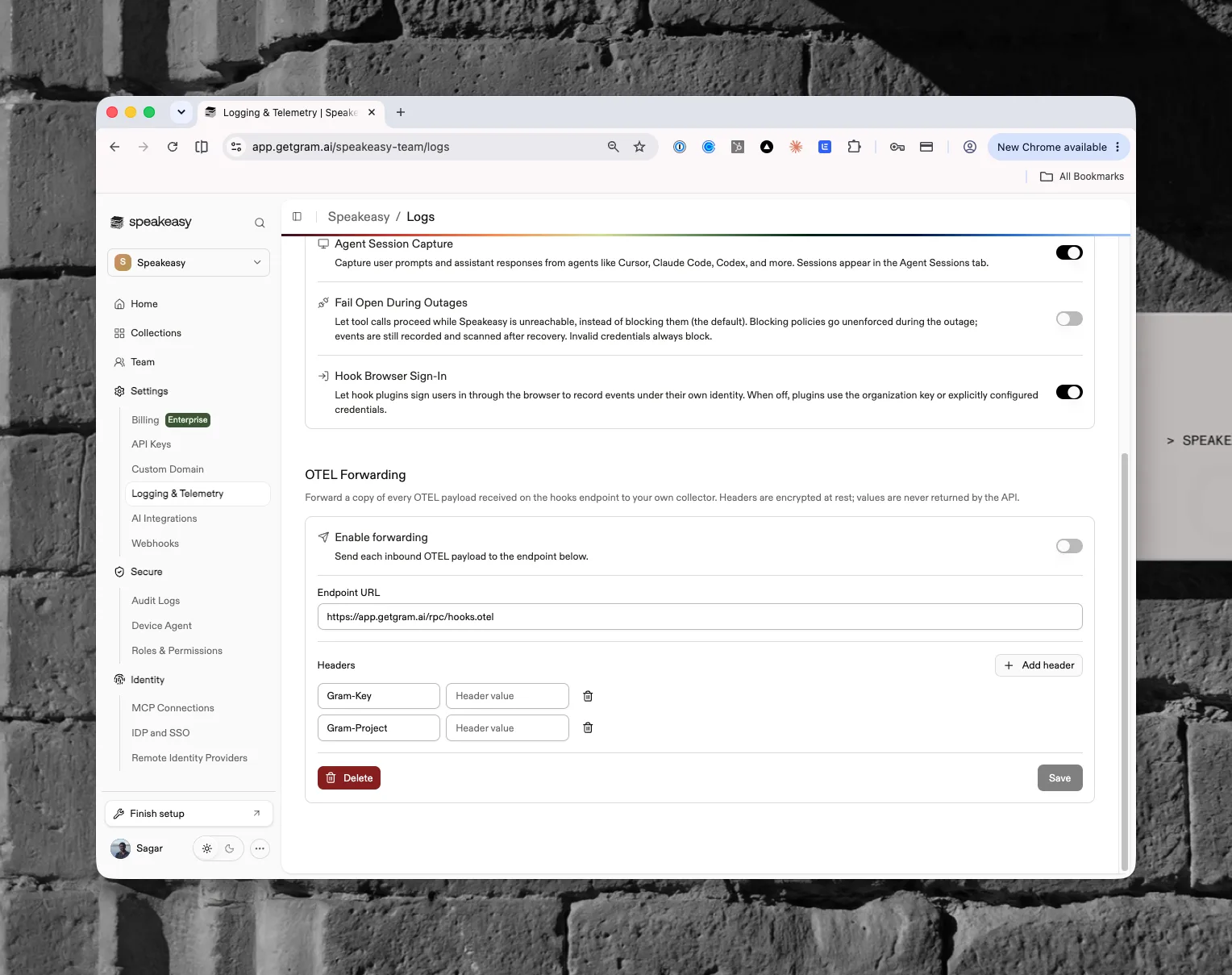
Header values are encrypted at rest and never returned by the API, so a stored
value renders as a masked placeholder rather than the real secret. Saving
replaces the entire header set with exactly what the form holds, so a row left
blank is saved as an empty value and the stored secret is lost. Retype every
header value before pressing **Save**.
**Delete** removes the forwarding configuration entirely, including the stored header values. Both saving and deleting are recorded in [Audit Logs](/docs/ai-control-plane/org-admin/audit-logs), capturing the endpoint URL, the enable flag, and header names only.
## What gets forwarded
Forwarding covers the OTEL logs and metrics payloads posted to the hooks endpoint. A few limits are worth knowing before pointing a collector at it.
- Payloads larger than 4 MiB are not forwarded. The platform still ingests and processes them as normal.
- Delivery is asynchronous and is not retried. If the collector is down or returns an error, that payload is dropped and the failure is logged rather than replayed.
- Forwarding failures never affect the agent sending the telemetry, and never affect what the platform records.
- Requests are only forwarded when the inbound payload carries a recognized hooks API key, since the key identifies which organization's configuration applies.
- Agents that emit no OTEL, such as [OpenCode](/docs/ai-control-plane/distribute/plugins/opencode), send hook events rather than OTEL payloads, so nothing from those agents is forwarded. The platform still ingests and scans those events as normal.
## Sending telemetry to the platform
OTEL forwarding covers the outbound direction. Pointing agents at the platform's hooks endpoint in the first place is a separate setup step. See [distributing plugins to Anthropic](/docs/ai-control-plane/distribute/plugins/anthropic) for Claude Code and Claude Cowork, [distributing plugins to OpenCode](/docs/ai-control-plane/distribute/plugins/opencode) for the plugin-only path, or the [device agent](/docs/ai-control-plane/org-admin/device-agent) for fleet-wide configuration.