How Cisco gave 90,000 employees an AI agent

Cameron McClellan
Published · 12 min read
In August 2026, Cisco began rolling out MyAgent, an AI agent that executes supervised autonomous workflows across Outlook, Webex, Jira, and SharePoint, to its 90,000 employees.
An agent with persistent memory that acts on email, meetings, tickets, and documents is the kind of deployment security teams block. Cisco could approve it because the agent runs on infrastructure the company had been building since 2022 to combat shadow AI adoption, and the adoption numbers show how well that groundwork paid off:
- Circuit, Cisco’s internal AI platform, reaches more than 100,000 users at 90% employee adoption, a user base that extends beyond the 90,000-employee headcount.
- More than 21,000 Cisco engineers use AI coding tools, over 80% of them weekly.
- Engineers report saving an average of six hours per week, and employees across the broader business five.
- Agentic interactions on the platform grew nearly 350% quarter over quarter.
This article covers what Cisco built underneath the agent, why the governed layer came before scale, and how to get the same result without the four-year build.
What is Cisco Circuit, the AI platform underneath MyAgent?
Circuit is what Srini Namineni, Cisco’s SVP and Chief Automation Officer, calls “the front door to AI at Cisco”: a secure, governed, multi-model platform through which employees access approved models, connect AI to enterprise data, share prompts and projects, and build their own connectors and agents.
That single front door is what makes the MyAgent rollout possible. MyAgent is built on Circuit, so it inherits the platform’s controls rather than needing its own. Per Thimaya Subaiya, Cisco’s EVP of Operations, the agent only reaches approved models, approved systems, and enterprise-appropriate data pathways, with security and human oversight designed in from the start. Cisco calls this “human-in-control” oversight. The agent proposes and executes supervised workflows, and a person stays in charge of what it is allowed to do.
The diagram below shows the relationship. The agent sits on top, the governance platform enforces the rules in the middle, and the enterprise systems the agent acts on sit underneath.
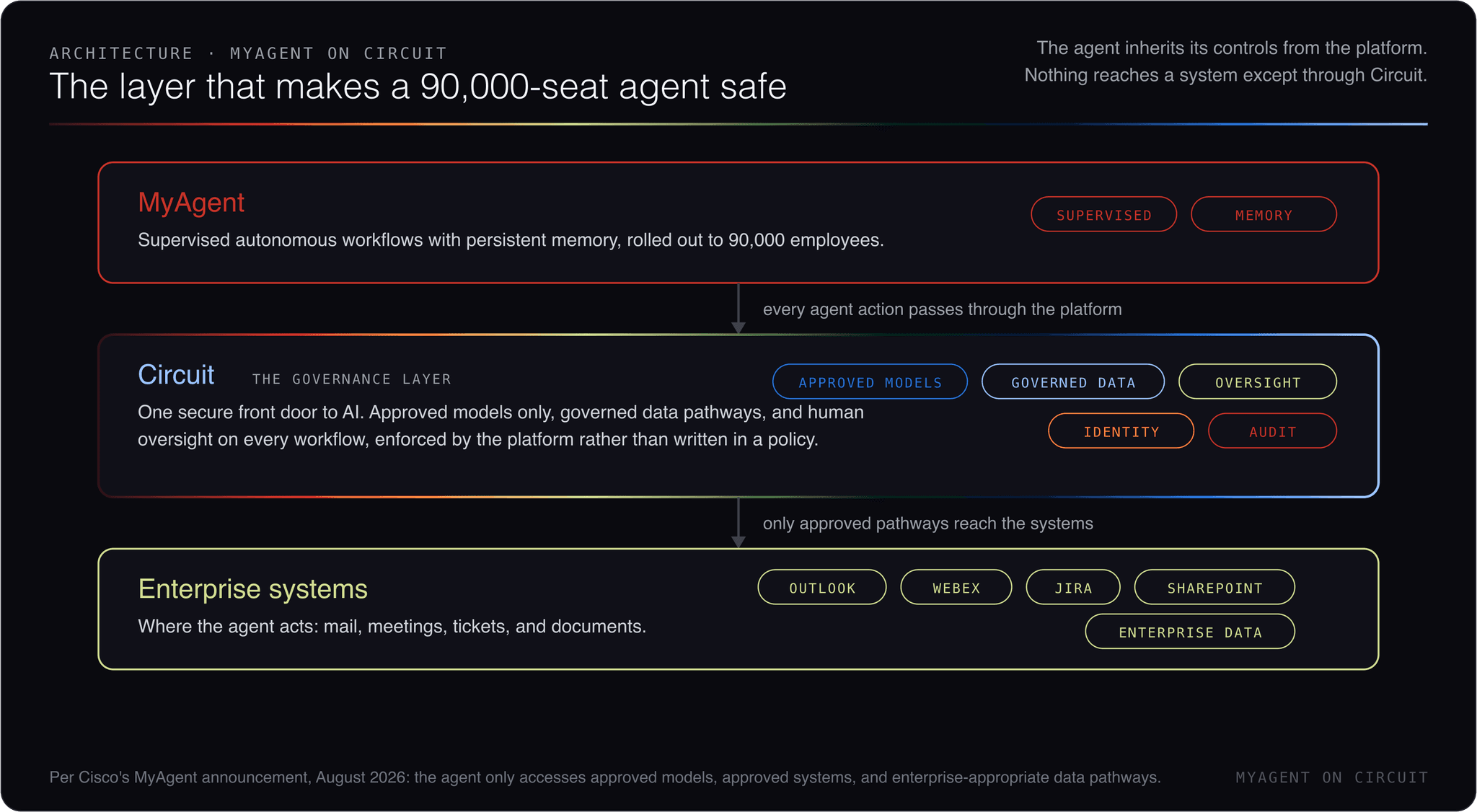
Namineni is explicit that the governed layer is the enabling condition, not a compliance afterthought: “Agents need trusted data, secure access, enterprise context, and clear governance.” The goal, in his framing, is not maximum autonomy but the right level of autonomy for the right task.
Why did Cisco build its own AI governance platform?
Because employees were already using AI through tools Cisco didn’t control.
When generative AI tools first appeared, Cisco watched its employees immediately start experimenting with consumer AI tools. The team concluded that without a secure alternative, shadow AI would become the default. That left two options: try to stop employees from using AI, or give them something better than the ungoverned tools they were already reaching for. Cisco chose the second option.
Shadow AI doesn’t respond to prohibition, because the employees using unsanctioned tools are trying to do their jobs faster. The only durable fix is to make the sanctioned path the easiest one. Circuit’s 90% adoption shows employees taking the governed path without being required to.
The same logic explains why governance had to come first rather than being retrofitted later. A platform that aims to be the default for 90,000 people is going to carry customer data, financial data, and source code on day one. The controls could not wait for the adoption curve.
How long did Cisco take to build its AI governance platform?
For Cisco, about four years, across three generations of internal products.
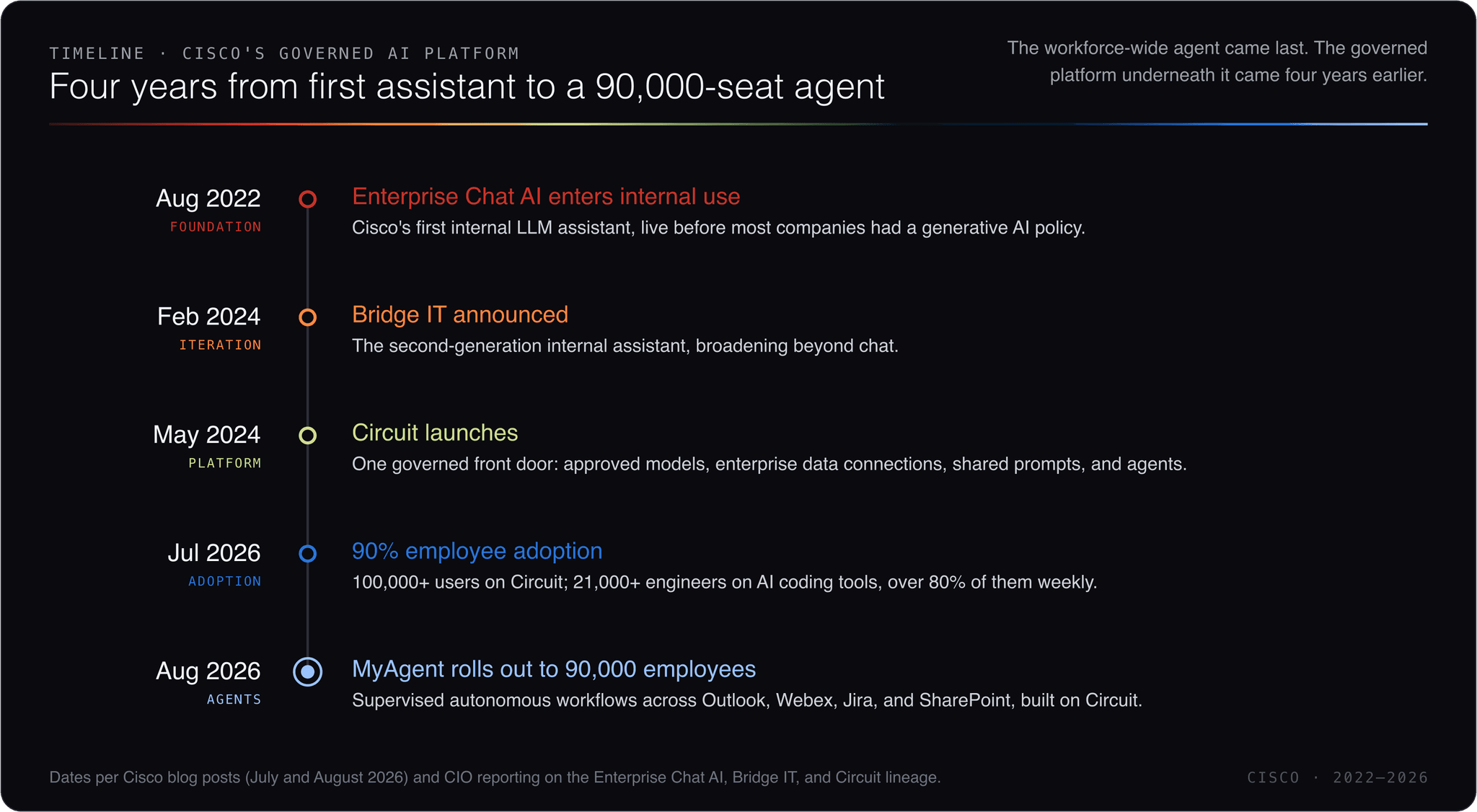
Cisco’s first internal LLM assistant, Enterprise Chat AI, has been in use since August 2022, per CIO’s reporting on Cisco’s AI journey. A broader successor, Bridge IT, was announced in February 2024, and Circuit launched in May 2024 as the evolution of both. The path to enterprise AI adoption required two more years of iteration, from Circuit’s May 2024 launch to 90% adoption in July 2026, with MyAgent arriving on top in August 2026.
The timeline below shows the full arc: the agent every employee now uses is the last step in a four-year sequence, not the first.
The build also required a standing organization. Circuit is run out of the Cisco Automation and AI Center under a Senior Vice President who holds the title of Chief Automation Officer, and the MyAgent announcement came from the EVP of Operations. Cisco has not disclosed what the platform cost, and any dollar figure would be a guess, but the org chart alone says the investment is measured in dedicated senior headcount over multiple years.
The infrastructure choices point the same way. Cisco runs internal AI inference on its own hardware, on premises, because cloud inference costs for spiky internal workloads were swinging as much as 5x month to month and the company wanted direct control over where its data goes. Cisco’s CFO Mark Patterson has described the cost model in interviews with Fortune: route routine work to scripts and smaller open-source models on Cisco’s own servers, and reserve frontier models for the reasoning tasks that need them.
Which other enterprises built AI governance platforms in-house?
Cisco’s sequence, governance platform first and mass rollout second, is the same one the other large-scale enterprise AI deployments followed.
Uber built the same layers itself: an LLM gateway that redacts PII and audits every model call, an MCP gateway and registry governing tool access to 10,000+ internal services, and an agent identity system that traces every action back to the human who initiated it. That build took years and a dedicated platform engineering team, and it is what let Uber scale to 84% of developers using agentic coding tools daily.
JPMorgan built LLM Suite, its internal AI platform, entirely in-house, and then onboarded 200,000 employees within eight months. By late 2025, CNBC reported that about 250,000 employees had access, with roughly half using it daily, and the bank’s AI/ML leadership described around 450 AI proofs of concept in flight, per Tearsheet. A regulated bank does not hand LLMs to a quarter of a million people without the governance, controls, and auditability coming first, which is why it built the platform rather than buying seats on a consumer tool.
The pattern is now big enough that analysts track it as a market. Gartner projects that spending on AI governance platforms will reach $492 million in 2026 and surpass $1 billion by 2030.
Why can’t most enterprises build their own AI governance?
Cisco started in August 2022, before most companies had a generative AI policy at all, so it had a four-year head start. It could fund a standing automation org with senior executive ownership. It could put inference on its own data center hardware. And it could iterate through three product generations before the payoff arrived, because the payoff was strategic rather than quarterly.
Most enterprises have none of those conditions. Cisco’s own AI Readiness Index finds that only 13% of organizations qualify as fully prepared to deploy AI, and only about a quarter say they can properly control what AI agents do with guardrails in place. Employees everywhere are already using consumer AI tools, sanctioned or not, the behavior Cisco saw in 2022. The gap between “our people are already using AI” and “we have a governed platform for it” is the multi-year build described above, and it is the bottleneck for everyone who didn’t start in 2022.
How Speakeasy delivers an AI governance layer in weeks
Cisco, Uber, and JPMorgan each spent years building the same governance layer, because without it a workforce-scale AI rollout does not survive security review. The layer serves the same purpose at any company deploying AI agents. What has changed is that it no longer has to be built by hand.
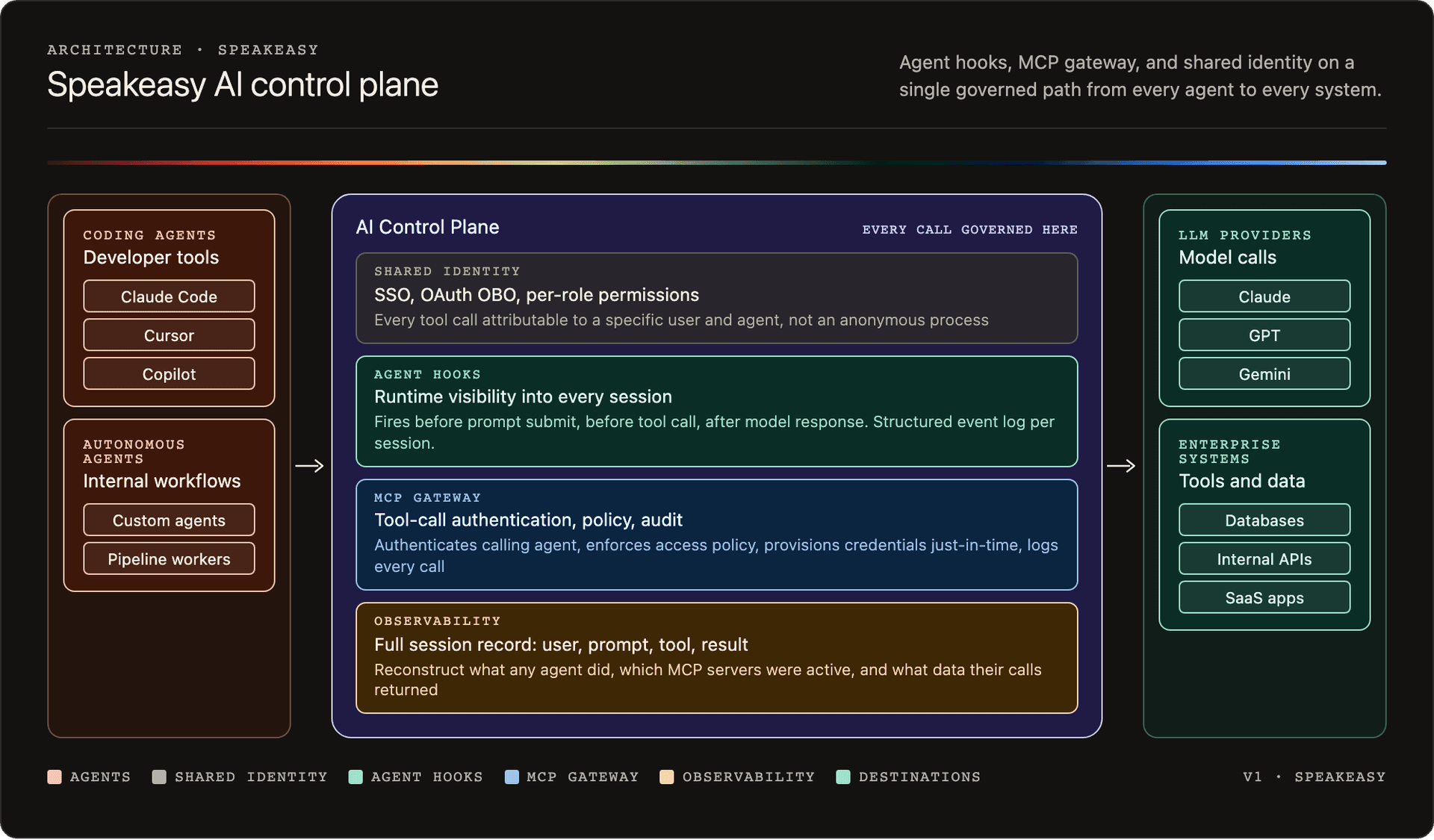
The layer Cisco built into Circuit is not specific to Cisco. Strip away the branding and it is a short list of controls: one governed front door, approved tools and data pathways only, identity attached to every action, policy enforced on every call, and an audit trail for all of it. The Speakeasy AI control plane ships that list as a product:
- MCP gateway. A registry and gateway governing which tools and data agents can reach, scoped per team and per role, so “approved systems and enterprise-appropriate data pathways” is enforced infrastructure rather than policy language.
- Identity and access. Integration with your identity provider (Okta, Entra ID, and any SAML or OIDC provider), so every agent action is tied to an authenticated person, the way MyAgent’s actions are tied to the employee running it.
- Policy enforcement and threat detection. Executable allow, deny, and transform rules on every call, with detection for PII and secrets leaving the boundary, prompt injection, and shadow tools.
- Observability and audit. Every prompt, response, and tool call captured, with adoption analytics and SIEM integration, which is both the oversight layer and the evidence record.
- Agent hooks. Policy enforcement at the tool-call boundary inside agent runtimes like Claude Code and Cursor, the layer endpoint and network controls can’t see.
The diagram below shows how those pieces fit together: every agent call routes through the control plane before reaching any model or internal system, the same single-front-door architecture Circuit enforces at Cisco.
The practical difference is what it costs to get there. Cisco’s path ran through three product generations and a standing automation org. MoonPay’s path ran through a 30-day proof of concept: the Speakeasy AI control plane stood up across its real AI agents, with SSO live, custom MCP servers behind the gateway, and audit logs capturing every tool call within weeks, before converting into a company-wide production deployment in a single rollout.
The comparison below is scoped to the governance layer. Cisco also built the platform around it, from model hosting to its own inference hardware, but the agents and AI tools employees want already exist off the shelf. What most companies are missing is the governed layer between those tools and their systems, and that is the part that no longer needs a custom build.
| Building it in-house (Cisco) | Buying it (Speakeasy) | |
|---|---|---|
| Time to a governed AI layer | About four years, 2022 to 2026 | Weeks; MoonPay went from a 30-day proof of concept to company-wide production |
| Team required | A standing automation org with senior executive ownership | Your existing security team; no platform team to hire |
| Infrastructure | Own on-prem inference and platform hardware | Managed cloud, or self-hosted in your own VPC |
| Governance controls | Approved models, governed data pathways, oversight, and audit, all built and maintained internally | MCP gateway, identity, policy enforcement, threat detection, and audit as maintained product features |
| Compliance evidence | Internal audit tooling | SOC 2 Type II and ISO 27001 certified, with exportable audit trails and SIEM integration |
| Coverage as AI tools change | Every new agent runtime is a new internal integration project | Spans the agents employees already use, including Claude, Cursor, and Codex |
Cisco governed first and scaled second, and reached 90% adoption. Speakeasy exists so that the first step takes weeks instead of years. Explore the AI control plane.
Further reading
- What is an AI control plane?: the architecture that spans gateway, identity, policy, and observability.
- How Uber built the enterprise AI security playbook: the engineering-side version of the same build.
- 2026 is the year of enterprise AI governance: why boards and CISOs now treat governance as infrastructure.
- What is shadow AI and how do you detect it?: the problem that forced Cisco’s choice, and what to do about it.
- MCP gateway architecture and governance: the enforcement layer for agent tool access.
- How MoonPay brought its AI sprawl under control: the weeks-not-years version of the same rollout.
Frequently asked questions
What is Cisco MyAgent? MyAgent is the AI agent Cisco began rolling out to its 90,000 employees in August 2026. It executes supervised autonomous workflows across Outlook, Webex, Jira, and SharePoint, holds persistent memory of a user’s preferences and context, and operates under a “human-in-control” oversight model. It runs on Circuit, Cisco’s internal AI platform, and only accesses approved models, approved systems, and enterprise-appropriate data pathways.
What is Cisco Circuit? Circuit is Cisco’s internal AI platform, described by the company as the front door to AI at Cisco. Launched in May 2024 and reaching 90% employee adoption by July 2026, it gives employees one secure, governed, multi-model interface for accessing approved models, connecting AI to enterprise data, sharing prompts and projects, and building connectors and agents.
Why did Cisco build its own AI governance platform? When generative AI emerged, Cisco employees immediately began experimenting with consumer AI tools, and the company concluded that without a secure alternative, shadow AI would become the default. Rather than trying to ban AI use, Cisco built a governed platform as the sanctioned alternative, and Circuit now reports 90% employee adoption.
How long does it take to implement enterprise AI governance? Built from scratch, it is a multi-year project: Cisco’s build ran from 2022 to 2026, and Uber’s governance stack similarly took years with a dedicated platform team. Bought as a product, the same layer deploys in weeks. MoonPay stood up the Speakeasy AI control plane across its production AI agents in a 30-day proof of concept and then rolled it out company-wide.
Do smaller enterprises need the same AI governance layer as Cisco? The risks scale down but don’t disappear: any company whose employees connect AI agents to email, documents, customer data, or internal systems has the same exposure to data leakage, ungoverned tool access, and unauditable agent actions. The controls Cisco built (approved tools, identity on every action, policy enforcement, and audit logging) apply at any size. The difference is that smaller enterprises can’t fund a multi-year build, which is what an off-the-shelf AI control plane is for.