Skills management: a system of record for your team's agent skills

Nolan Di Mare Sullivan
August 7, 2026 · 6 min read
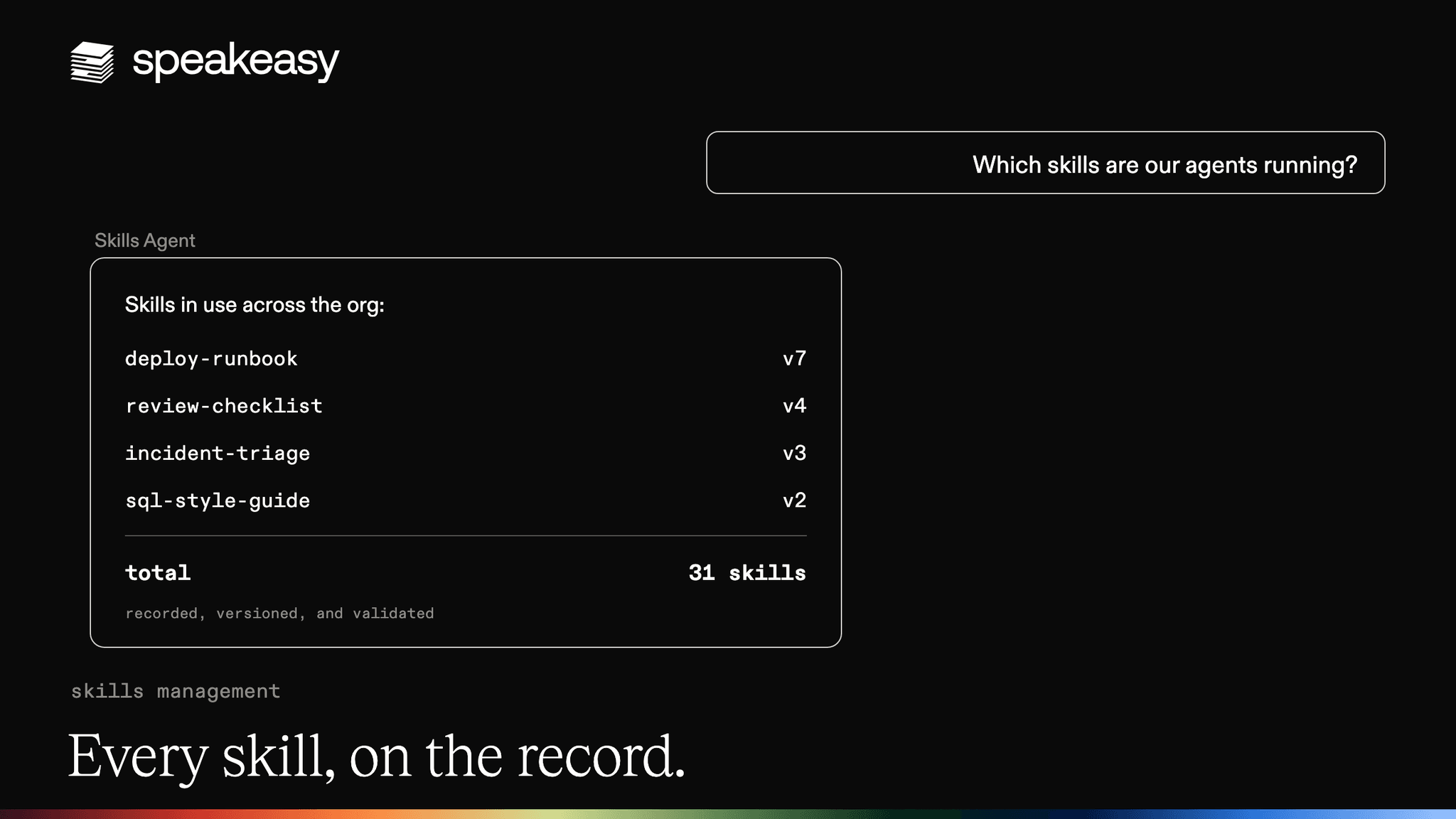
An agent skill is a reusable instruction document in the Agent Skills format: a SKILL.md file with YAML frontmatter and a markdown body. An increasing organizations are using skills to codify their company’s shared way of working. Its a powerful technique for shaping the agents that company’s are relying on for their everyday work. However, organizations adopting skills are accumulating them at an alarming rate: deploy runbooks, review checklists, style guides, incident procedures.
Currently, skills live scattered across repos, .claude/skills/ folders, personal ~/.claude/skills/ collections, and plugins. There’s no organizational system of record: no way to see what skills exist across the team, share the good ones, or know whether the copy on your machine matches the one your teammate improved last week.
Speakeasy skills management closes that gap. Your team gets one place to record, version, and browse the skills it relies on.
Why skills need a system of record
Skills are the easiest way to make your agents better at your work. Someone records important context on how something works at the company: what a good review comment looks like, how much memory is needed to build the web app, what the obscure columns in the datalake are for. Every agent that reads a skill inherits that knowledge.
Skills are also very cheap, just a simple markdown file. But because a skill is a file, it spreads like a file. It gets copied into a repo, pasted into a Slack thread, tweaked on someone’s laptop, and forked into four versions that no longer agree. Nobody knows which copy is the most recent iteration, whether the fix from last week made it to anyone else, or how many skills the team has written for the same task without noticing.
Every other kind of shared artifact solved this the same way, with a registry. Packages, containers, and models all needed one place where a name resolves to a specific piece of content, where history is durable, and where the answer to “which version are you running” exists. Skills are now an artifact your team ships to its agents, and they need the same thing: a named record, an immutable version for every change, and a shared view of what exists.
How skills management works
Most skills registries start life as a Github repo, but a repo full of SKILL.md files only gets you so far. It stores skills, but it can’t tell you which ones agents actually use, whether they help, or which ones your team wrote twice without noticing.
Speakeasy skills management works the same way every mature registry (npm, OCI, HuggingFace) does:
- Name-routed uploads. An upload whose frontmatter name matches an existing skill lands as a new version rather than a duplicate, and re-uploading identical content is a no-op, so ten people can record the team’s favorite skill and Speakeasy keeps one clean record.
- Immutable versions. A skill’s name is a mutable pointer, while each version is identified by the SHA-256 hash of its content and is immutable forever. New content appends a version, nothing overwrites, and a retired skill is archived rather than deleted. Content is canonicalized before hashing, so formatting noise never mints a spurious version while a one-word edit does.
- Validation without gatekeeping. Every version is checked against the Agent Skills spec, but an invalid skill is still accepted, stored, and badged Invalid with the specific errors listed, so you can record what exists today and fix it in place.
- Browse and audit. Every skill is searchable from the Skills page, with a detail view showing the rendered markdown, its frontmatter summary, and the full version history with diffs between any two versions.
- Scoped access. Dedicated
skill:readandskill:writeRBAC scopes let you decide who curates skills and who consumes them.
An AI-native approach to artifact management
Storing versions is table stakes. Because every version here is content-addressed and every agent run attributes back to the exact skill it used, skills management can close the development loop in a way git repos alone never could: see what your team actually runs, measure whether it helps, and pull the good skills out of the wild and into the standard.
Usage analytics
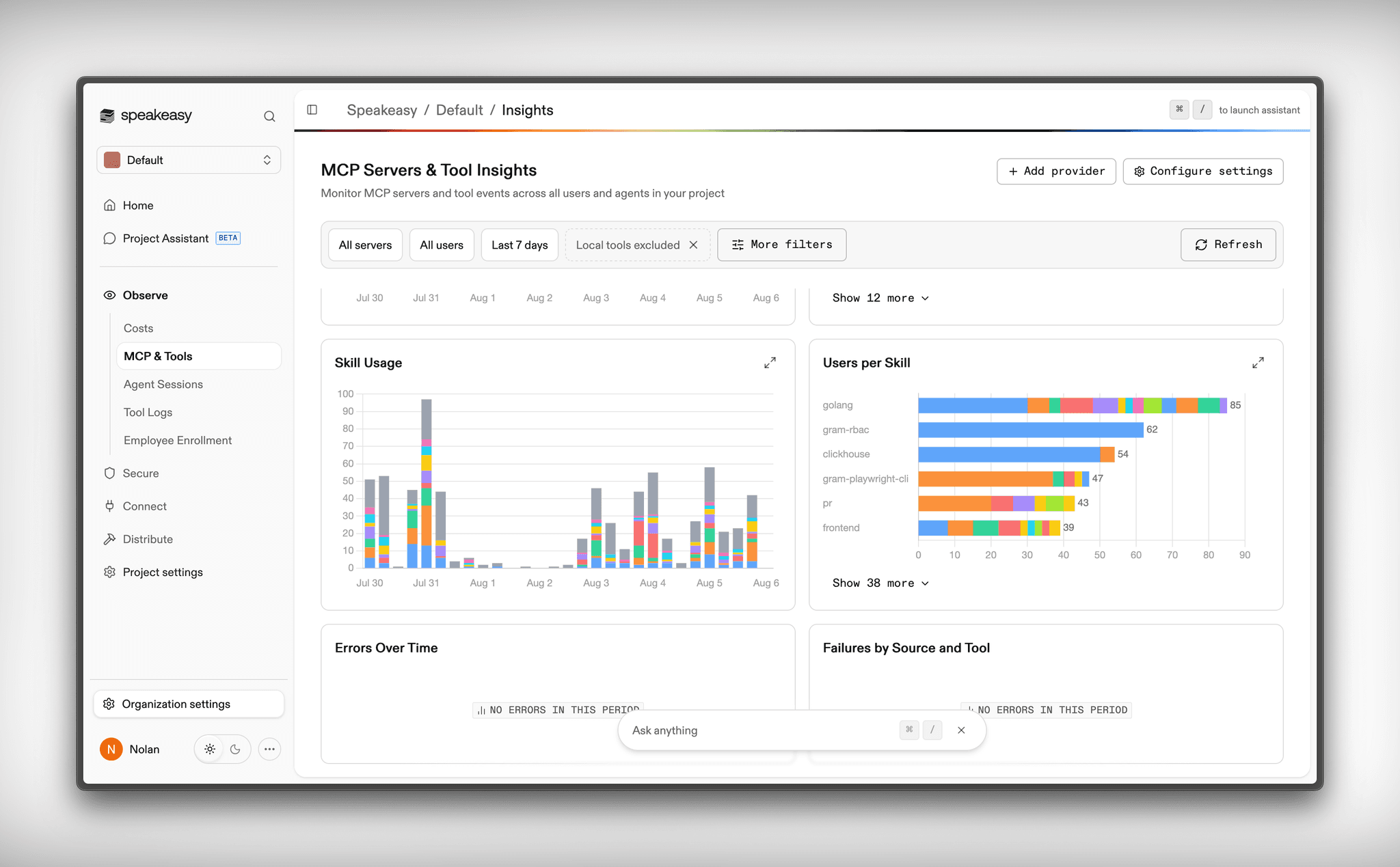
See which skills load, how often, on which projects, and by whom. Quickly idenitfy which skills have become daily drivers and which ones nobody has touched since upload. Speakeasy consolidates duplicate skills, and flags dormant skills as candidates to archive. You get an honest map of what your team relies on instead of an ever growing git repo.
Performance measurement and improvement
Because each version is content-addressed, every agent sessition’s skills usage is attributed to an exact version. That enables you to measure the actual impact of a skill instead of guessing. When a skill changes, you see what metrics change with it: task completion rate, token spend, how often the agent needed a second pass. That measurement then feeds back into the skill to complete the loop. An LLM judge analyzes the runs where a skill underperformed and proposes edits, you review the diff, and publish the next version. Skills get sharper each cycle instead of ossifying the moment they’re written.
Capture and promotion
The best skills rarely start out official. They start on one developer’s laptop, solving a problem they encountered. In the best case, the skill gets socialized to everyone who could benefit. In the worst case, it stays on that developer’s laptop. Speakeasy’s device agent make sure every useful skill is identified. It runs inventory on the skills being use across every machine. It identifies new skills, performs a security check and nominates them for promotion so the whole team can benefit. Team-based distribution puts it on the right machines automatically: the deploy runbook to Engineering, the pricing skill to Sales. What works in the wild becomes the standard.
Observe what works, standardize it, distribute it, and improve it as the usage data flows back. That loop is the point of skills management, and the identity and versioning decisions in this release are what make it possible.
Get started
Open the Skills page in your Speakeasy dashboard, click Add skill, and paste or upload a SKILL.md. Validation feedback is inline, and the skill is browsable by your whole team the moment it saves. If you’re looking for skills worth recording first, our open-source collection of OpenAPI and SDK skills is a good place to start.
Want help building an organizational library of the skills your agents run best with? Book time with our team and we’ll walk through it.
Last updated on