How to connect OpenAI Agents SDK to MCP
The OpenAI Agents SDK is a production-ready framework for building agentic AI applications. The Agents SDK provides advanced features like persistent sessions, agent handoffs, guardrails, and comprehensive tracing for complex workflows.
When combined with Gram-hosted MCP servers, the Agents SDK enables you to build sophisticated agents that can interact with your APIs, databases, and other services through natural language conversations with persistent context.
This guide shows you how to connect the OpenAI Agents SDK to a Gram-hosted MCP server using Taskmaster, a full-stack CRUD application for task and project management. Taskmaster includes a web UI for managing projects and tasks, a built-in HTTP API, OAuth 2.0 authentication, and a Neon PostgreSQL database for storing data. Try the demo app to see it in action.
You’ll learn how to set up the connection, configure agents with MCP tools, and build conversational task management workflows.
Understanding OpenAI API options
Section titled “Understanding OpenAI API options”OpenAI provides three main approaches for integrating with MCP servers:
- The Responses API: An API with a simple request-response pattern, ideal for basic tool calling and quick integrations.
- The Agents SDK (this guide): An advanced agent framework with sessions, handoffs, and persistent context that is perfect for complex conversational workflows.
- ChatGPT Connectors: Connectors offer direct ChatGPT integration to end users via a web UI.
If you’re unsure which approach fits your needs, start with the Responses API guide for simpler implementations or try ChatGPT Connectors for a web UI solution.
Prerequisites
Section titled “Prerequisites”To follow this tutorial, you need:
- A Gram account
- A Taskmaster MCP server set up and configured
- An OpenAI API key
- A Python environment set up on your machine
Creating a Taskmaster MCP server
Section titled “Creating a Taskmaster MCP server”Before connecting the OpenAI Agents SDK to a Taskmaster MCP server, you first need to create one.
Follow the guide to creating a Taskmaster MCP server, which walks you through:
- Setting up a Gram project with the Taskmaster OpenAPI document
- Getting a Taskmaster API key from your instance
- Configuring environment variables
- Publishing your MCP server with the correct authentication headers
Once you have your Taskmaster MCP server configured, return here to connect it to the OpenAI Agents SDK.
Connecting Agents SDK to your Gram-hosted MCP server
Section titled “Connecting Agents SDK to your Gram-hosted MCP server”The OpenAI Agents SDK supports MCP servers through the HostedMCPTool class. Here’s how to connect to your Gram-hosted MCP server:
Installation
Section titled “Installation”First, install the required packages:
pip install openai-agentsSet your OpenAI API key and Taskmaster credentials:
export OPENAI_API_KEY=your-openai-api-key-hereexport MCP_TASKMASTER_API_KEY=your-taskmaster-api-keyexport GRAM_KEY=your-gram-api-key # Optional: only needed for private MCP serversCode Examples
Throughout this guide, replace your-taskmaster-slug with your actual MCP
server URL and update the header names to match your server configuration from
the guide to creating a Taskmaster MCP
server.
Basic connection (public server)
Section titled “Basic connection (public server)”Here’s a basic example using a public Gram MCP server:
import osfrom agents import Agent, Runner, HostedMCPTool
# Configure the Taskmaster MCP tooltaskmaster_tool = HostedMCPTool(    tool_config={        "type": "mcp",        "server_label": "taskmaster",        "server_url": "https://app.getgram.ai/mcp/your-taskmaster-slug",        "headers": {            "MCP-TASKMASTER-API-KEY": os.getenv("MCP_TASKMASTER_API_KEY")        },        "require_approval": "never"    })
# Create an agent with the MCP toolagent = Agent(    name="Task Manager",    instructions="You help users manage their tasks and projects using Taskmaster. Be helpful and conversational.",    tools=[taskmaster_tool])
# Run the agentresult = Runner.run_sync(agent, "What tasks do I have?")print(result.final_output)
Authenticated connection
Section titled “Authenticated connection”For authenticated Gram MCP servers, include the appropriate authentication headers. The exact format varies by MCP server.
import osfrom agents import Agent, Runner, HostedMCPTool
# Load Taskmaster credentials from environmentGRAM_KEY = os.getenv("GRAM_KEY")
if not GRAM_KEY:    raise ValueError("Missing Gram environment variable")
# Configure authenticated Taskmaster MCP tooltaskmaster_tool = HostedMCPTool(    tool_config={        "type": "mcp",        "server_label": "taskmaster",        "server_url": "https://app.getgram.ai/mcp/your-taskmaster-slug",        "headers": {            "Authorization": f"Bearer {GRAM_KEY}",        },        "require_approval": "never"    })
agent = Agent(    name="Task Manager",    instructions="You help users manage their tasks and projects using Taskmaster.",    tools=[taskmaster_tool])
result = Runner.run_sync(agent, "Create a new task called 'Review OpenAI Agents SDK integration'")print(result.final_output)
Understanding the configuration
Section titled “Understanding the configuration”Each parameter in the tool_config does the following:
type: "mcp"specifies that this is an MCP tool.server_labeladds a unique identifier for your MCP server.server_urladds your Gram-hosted MCP server URL.headersadds authentication headers (optional for public servers).require_approvalcontrols tool call approval behavior.
Advanced agent features
Section titled “Advanced agent features”The Agents SDK provides several advanced features that go beyond simple tool calling.
Persistent sessions
Section titled “Persistent sessions”Unlike the Responses API, agents maintain conversation history automatically:
import osfrom agents import Agent, Runner, HostedMCPTool
taskmaster_tool = HostedMCPTool(    tool_config={        "type": "mcp",        "server_label": "taskmaster",        "server_url": "https://app.getgram.ai/mcp/your-taskmaster-slug",        "headers": {            "MCP-TASKMASTER-API-KEY": os.getenv("MCP_TASKMASTER_API_KEY")        },        "require_approval": "never"    })
agent = Agent(    name="Project Assistant",    instructions="""You are a project management assistant. You help users:    - Create and organize tasks    - Track project progress    - Set priorities and deadlines
    Remember context from previous interactions.""",    tools=[taskmaster_tool])
# First interactionresult1 = Runner.run_sync(agent, "Create a project called 'Website Redesign'")print("First:", result1.final_output)
# Second interaction - agent remembers the projectresult2 = Runner.run_sync(agent, "Add a task to that project: 'Design new homepage'")print("Second:", result2.final_output)
# Third interaction - agent maintains full contextresult3 = Runner.run_sync(agent, "What tasks are in the Website Redesign project?")print("Third:", result3.final_output)
Tool approval workflows
Section titled “Tool approval workflows”For production environments, you can implement approval workflows:
import osfrom agents import Agent, Runner, HostedMCPTool, MCPToolApprovalRequest, MCPToolApprovalFunctionResult
# Define which tools require approvalSAFE_TOOLS = {"list_tasks", "get_project"}RESTRICTED_TOOLS = {"delete_task", "delete_project"}
def approve_tool_call(request: MCPToolApprovalRequest) -> MCPToolApprovalFunctionResult:    tool_name = request.data.name
    if tool_name in SAFE_TOOLS:        return {"approve": True}    elif tool_name in RESTRICTED_TOOLS:        return {"approve": False, "reason": "Deletion operations require manual approval"}    else:        return {"approve": True}
taskmaster_tool = HostedMCPTool(    tool_config={        "type": "mcp",        "server_label": "taskmaster",        "server_url": "https://app.getgram.ai/mcp/your-taskmaster-slug",        "headers": {            "MCP-TASKMASTER-API-KEY": os.getenv("MCP_TASKMASTER_API_KEY")        },        "require_approval": "always"    },    on_approval_request=approve_tool_call)
agent = Agent(    name="Secure Task Manager",    instructions="You help manage tasks with safety checks in place.",    tools=[taskmaster_tool])
Error handling and retries
Section titled “Error handling and retries”The Agents SDK provides built-in error handling:
import osfrom agents import Agent, Runner, HostedMCPTool
taskmaster_tool = HostedMCPTool(    tool_config={        "type": "mcp",        "server_label": "taskmaster",        "server_url": "https://app.getgram.ai/mcp/your-taskmaster-slug",        "headers": {            "MCP-TASKMASTER-API-KEY": os.getenv("MCP_TASKMASTER_API_KEY")        },        "require_approval": "never"    })
agent = Agent(    name="Resilient Task Manager",    instructions="""You help manage tasks. If a tool call fails:    1. Explain what went wrong    2. Suggest alternative approaches    3. Try again if appropriate""",    tools=[taskmaster_tool])
try:    result = Runner.run_sync(agent, "Create a task with invalid data")    print(result.final_output)except Exception as e:    print(f"Agent error: {e}")
Building conversational workflows
Section titled “Building conversational workflows”The following complete example demonstrates building a conversational task management workflow:
import osfrom agents import Agent, Runner, HostedMCPTool
def create_task_manager_agent():    """Create a task management agent with Taskmaster integration"""
    taskmaster_tool = HostedMCPTool(        tool_config={            "type": "mcp",            "server_label": "taskmaster",            "server_url": "https://app.getgram.ai/mcp/your-taskmaster-slug",            "headers": {                "MCP-TASKMASTER-API-KEY": os.getenv('MCP_TASKMASTER_API_KEY')            },            "require_approval": "never"        }    )
    return Agent(        name="Taskmaster Pro",        instructions="""You are Taskmaster Pro, an expert project management assistant.
        Your capabilities:        - Create and manage projects and tasks        - Set priorities, deadlines, and track progress        - Provide project insights and recommendations        - Help with workflow optimization
        Be conversational, helpful, and proactive in suggesting improvements.        Always confirm important actions before executing them.""",        tools=[taskmaster_tool]    )
def interactive_session():    """Run an interactive task management session"""    agent = create_task_manager_agent()
    print("🎯 Taskmaster Pro is ready! Type 'quit' to exit.\n")
    while True:        user_input = input("You: ").strip()
        if user_input.lower() in ['quit', 'exit', 'bye']:            print("Taskmaster Pro: Goodbye! Your tasks are in good hands. 👋")            break
        if not user_input:            continue
        try:            result = Runner.run_sync(agent, user_input)            print(f"Taskmaster Pro: {result.final_output}\n")        except Exception as e:            print(f"Taskmaster Pro: Sorry, I encountered an error: {e}\n")
if __name__ == "__main__":    interactive_session()
Tool filtering and permissions
Section titled “Tool filtering and permissions”You can control which tools are available to your agent:
import osfrom agents import Agent, Runner, HostedMCPTool
# Create MCP tool with specific tool restrictionstaskmaster_tool = HostedMCPTool(    tool_config={        "type": "mcp",        "server_label": "taskmaster",        "server_url": "https://app.getgram.ai/mcp/your-taskmaster-slug",        "headers": {            "MCP-TASKMASTER-API-KEY": os.getenv("MCP_TASKMASTER_API_KEY")        },        "allowed_tools": [            "taskmaster_get_tasks",            "taskmaster_create_task",            "taskmaster_update_task",            "taskmaster_get_projects"            # Note: Exclude deletion tools for read-only access        ],        "require_approval": "never"    })
agent = Agent(    name="Read-Only Task Viewer",    instructions="You can view and create tasks, but cannot delete anything.",    tools=[taskmaster_tool])
For example, Taskmaster MCP servers provide tools like taskmaster_get_tasks, taskmaster_create_task, taskmaster_delete_task, taskmaster_get_projects, and taskmaster_create_project. The exact tool names depend on your MCP server configuration.
Testing your integration
Section titled “Testing your integration”Validating MCP server connectivity
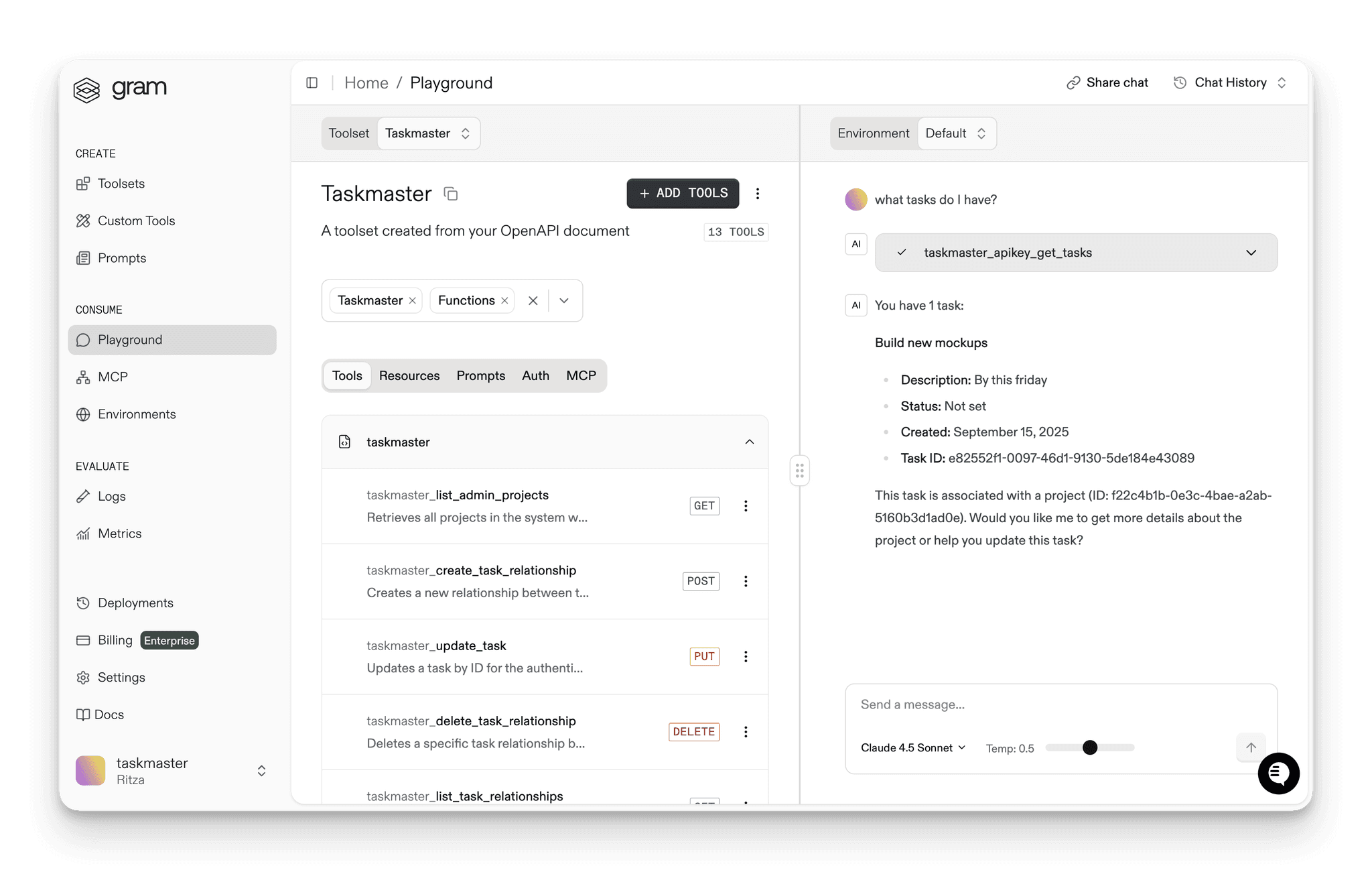
Section titled “Validating MCP server connectivity”Before building complex workflows, test your Gram MCP server in the Gram Playground to ensure the tools work correctly.
Using the MCP Inspector
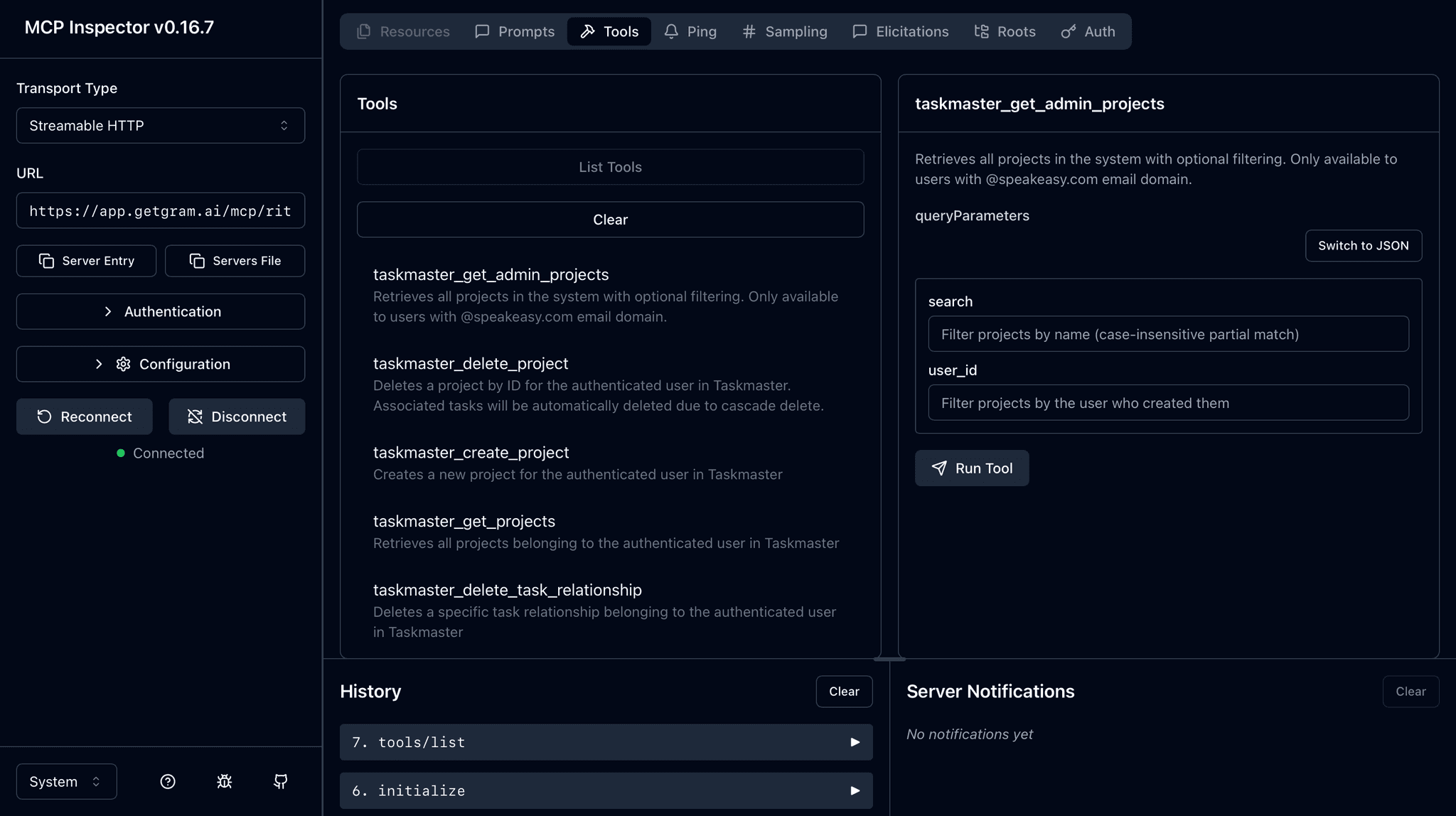
Section titled “Using the MCP Inspector”You can also use the MCP Inspector to test your Gram MCP server:
npx -y @modelcontextprotocol/inspectorWhen the browser opens:
- In the Transport Type field, select Streamable HTTP (not the default stdio).
- Enter your server URL:
https://app.getgram.ai/mcp/your-taskmaster-slug. - For authentication, add API Token Authentication:
- Header name:
MCP-TASKMASTER-API-KEY - Bearer token: Your Taskmaster API key
- Header name:
- Click Connect to test the connection.
Note: Taskmaster servers use custom authentication headers that may not be fully supported by the standard MCP Inspector interface. For guaranteed testing, use the Gram Playground or the code examples in this guide.
Debugging agent interactions
Section titled “Debugging agent interactions”The Agents SDK provides built-in tracing for debugging:
from agents import Agent, Runner, HostedMCPTool
# Enable detailed loggingimport logginglogging.basicConfig(level=logging.DEBUG)
agent = Agent(    name="Debug Agent",    tools=[taskmaster_tool])
# Agent interactions will show detailed traces in the logsresult = Runner.run_sync(agent, "List my tasks")
What’s next
Section titled “What’s next”You now have the OpenAI Agents SDK connected to your Gram-hosted MCP server with advanced task management capabilities.
The Agents SDK’s features, like persistent sessions, approval workflows, and built-in error handling, make it ideal for building production-ready conversational agents that can handle complex workflows.
Ready to build your own MCP server? Try Gram today and see how easy it is to turn any API into agent-ready tools that work with both OpenAI and Anthropic models.