OpenCode now runs on the Speakeasy AI control plane

Swad Kukunooru
August 12, 2026 · 3 min read
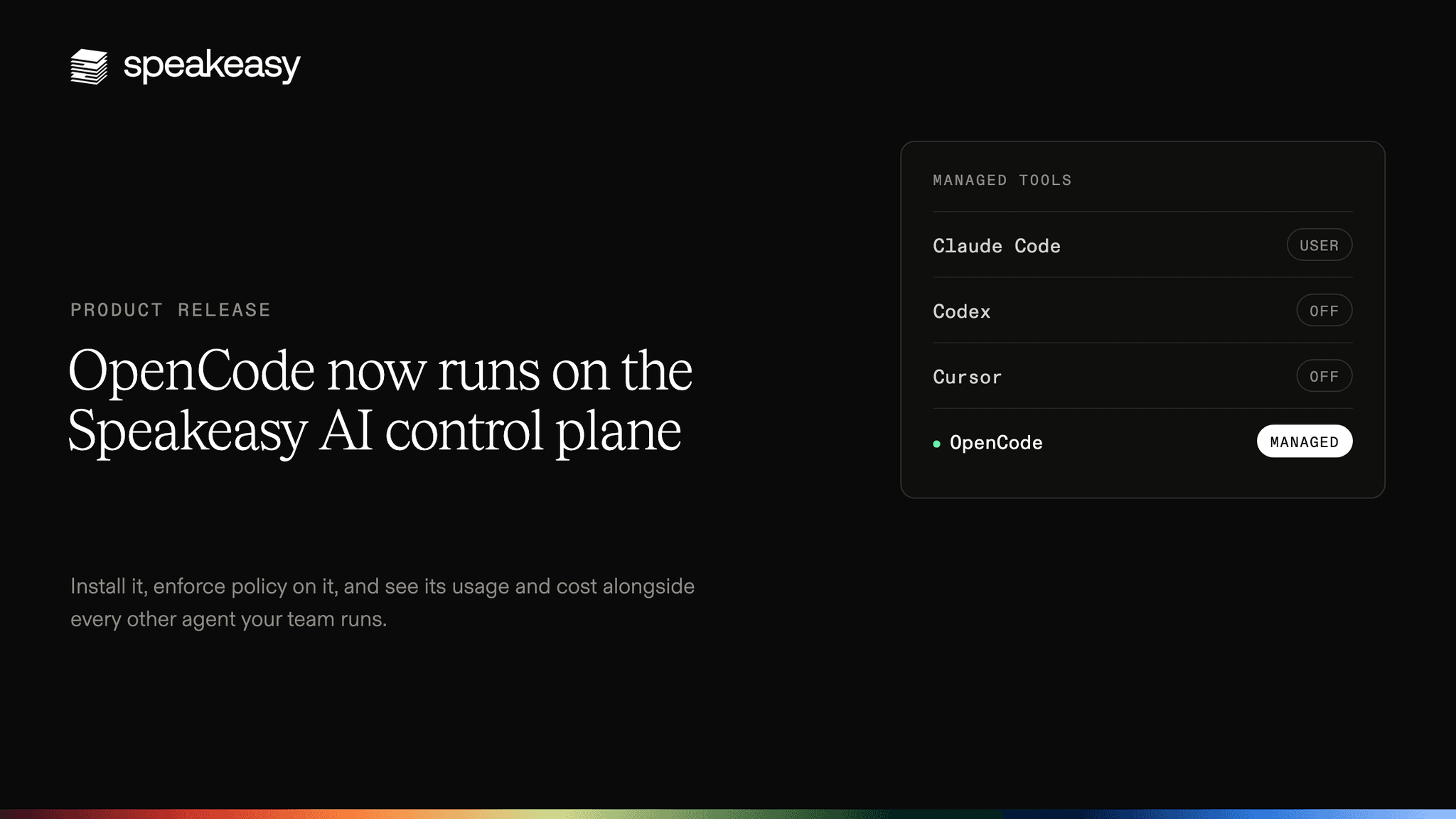
OpenCode has earned its following. The open source agent harness, built by the team at Anomaly, is the obvious choice for those who want a top-tier harness that is independent of the frontier AI Labs. OpenCode enables users to connect to more than 75 model providers, including local models. When a new model ships, developers can switch to it the same day without any disruption to their daily flow.
Yet OpenCode usage leads to the same set of questions that enterprise security teams ask about every agent: who’s running it, what is it connected to, what is it spending, and what stops it from doing something destructive?
As of today, Speakeasy answers those questions for OpenCode. It joins Claude Code, Codex, and Cursor as a fully supported agent on the AI control plane: your team can roll out OpenCode pre-configured to enterprise policy, then govern and observe it the same way you already do for the rest of your agent fleet.
Speakeasy + OpenCode
The control plane treats OpenCode like a first-class agent across each of its jobs: distributing AI capabilities to your team, monitoring agent actions, governing access, and enforcing policy.
Pre-configured to meet enterprise policy
You can now roll out OpenCode pre-configured, so every install in your organization starts out compliant with enterprise policy. Your platform team decides which MCP servers, models, and settings OpenCode ships with, and every machine in the fleet gets that exact configuration. A developer’s first session is already connected to approved servers and already inside policy, with no setup doc to follow and no drift between machines.
All your team’s agent usage in one dashboard
OpenCode sessions now report identity, model, token counts, and cost through the same pipeline as your other agents, visible in agent sessions alongside the rest of your fleet. OpenCode shows up next to Claude Code and Codex in the same usage and spend views, so a team that runs three different agents gets one answer to “what did we spend on AI this week” and can compare agents on equal footing.
Because OpenCode is provider-agnostic, this matters more than it does for single-vendor agents. Sessions carry the model that actually answered, so you can see spend split across Anthropic, OpenAI, and every other provider your developers route through. Credential arguments and MCP server URLs are redacted before anything is stored.
Policy enforcement on every tool call
The risk policies already protecting your other agents now apply to OpenCode too: prompt injection detection, destructive command blocking, and the plain-language rules you’ve written yourself, with the same warn-then-deny escalation and case-insensitive matching. A rule you wrote once, like “never run a force push” or “never touch production credentials,” now holds for OpenCode without any per-agent setup.
Enforcement runs inline, fast enough that it never stalls a turn. Developers keep the agent they chose, and the security team maintains a single policy surface across every agent in the fleet.
How to get started
To roll it out:
- Add OpenCode from the Instrument agents step in your Speakeasy dashboard for a guided install.
- Set its enforcement level under Managed tools on the Device Agent page to control how much of the configuration your platform team owns.
- Review your existing risk policies. They apply to OpenCode automatically, so this is a good moment to confirm the rules say what you want them to.
Running a fleet of mixed agents?
See how Speakeasy installs, governs, and monitors every AI agent your team runs from one dashboard.
Book a demoLast updated on