
How Fivetran scaled enterprise data integration with AI-powered workflows
Fivetran
Data
AI Control Plane
Speakeasy
Fivetran provides automated data movement for analytics, helping enterprises move data from sources to warehouses and lakes.
The breadth of Fivetran’s user base means enterprise customers constantly need custom connectors for internal APIs and niche third-party tools that fall outside their 700+ pre-built integrations. Building these longtail connectors traditionally requires significant engineering investment—resources most enterprises don’t have on hand.
For Lead Solution Architect Elijah Davis, the Model Context Protocol (MCP) provided a solution. By exposing Fivetran’s Connector SDK and platform APIs as MCP servers, he hypothesized that it would be possible to enable customers to use AI agents to build custom connectors through natural language.
“It was really clear that AI was going to change everything in terms of how customers would build on the Fivetran platform. Dramatically reducing the required engineering for building connectors suddenly makes automation viable for a bunch of workflows where the previously the juice wasn't worth the squeeze.”
Elijah Davis,
Lead Solution Architect
Building an enterprise MCP server
Elijah started off by building a standalone Python-based MCP server that customers could deploy locally. This worked for proof-of-concept demonstrations, but asking every customer to install a local server wasn’t a great user experience.
He began looking into building a hosted server, but had some immediate challenges. To run a production server would mean managing infrastructure, configuring an Oauth server, and testing support across various MCP clients. They were staring at weeks of work.
Then the team discovered the Speakeasy AI Control Plane. In 30 minutes Eli was running tests against a hosted server. In a couple of days, he had an OAuth server handling authentication. At the end of the week, he was ready to start serving production traffic.
Long-tail connector creation with MCP
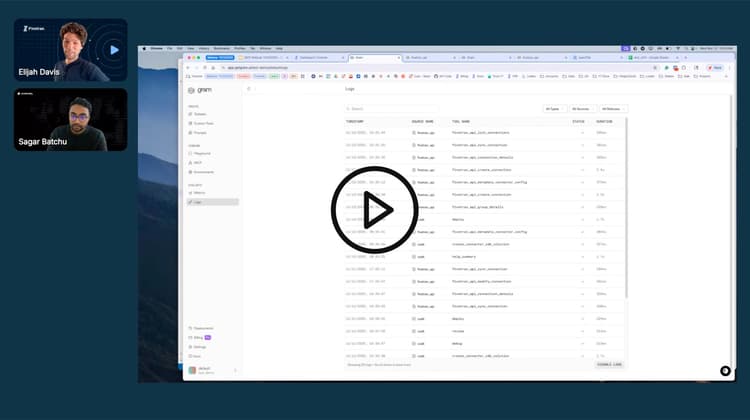
Watch Fivetran’s MCP-based connector creation in action
The primary workflow addresses one of the most time-consuming tasks in data integration: setting up new connectors. With hundreds of potential connectors and varying requirements across teams, even experienced engineers spend hours on manual configuration.
Through the Connector SDK and the AI Control Plane MCP tooling, users can describe what they want to connect in natural language. The AI agent generates all necessary files (connector.py, config.json, requirements.txt), incorporates Fivetran best practices, debugs issues when they arise, and deploys directly to Fivetran infrastructure.
And sometimes a description isn’t even necessary. By providing an API docs URL to the AI agent, it’s possible to create a custom connector. The agent learns context from the API documentation, then uses the MCP server to create the connector files, it debugs connection issues, and deploys the solution to Fivetran where it appears immediately in the dashboard. What previously required hours of engineering work is completed in minutes.
“When customers see it actually work, they light up. Once they realize they can manage their entire data pipeline through natural language, they immediately start thinking about all the other workflows they could automate.”
Elijah Davis,
Lead Solution Architect
The beginning of a transformation
Fivetran successfully deployed MCP integrations to enterprise customers across multiple industries. The solutions team now has a repeatable service offering: work with the customer to understand their workflows, configure custom toolsets in the AI Control Plane, and enable their teams to automate data operations through natural language.
And custom connectors are really just the beginning. Fivetran has embraced AI evolution across their entire product suite. Experiments into AI-based onboarding, and creating chat-based interfaces are only just getting underway.
“We want customers to be able to interact with Fivetran and any other tools they need through a natural language interface. With [Speakeasy] handling the infrastructure, we can focus on enabling that experience everywhere it makes sense.”
Elijah Davis,
Lead Solution Architect
For enterprises exploring AI-powered data operations, Fivetran’s approach demonstrates a clear path forward: identify high-value workflows, validate with customers before heavy investment, and leverage specialist infrastructure to focus engineering resources on customer success. In the enterprise world, knowing what not to build yourself is often the fastest path to value.
Info sheet
Company
Fivetran
Website
fivetran.comAbout
Automated data movement for analytics, helping enterprises move data from sources to warehouses and lakes
Industry
Data, AI Control Plane
Related customers
FinTech
Security
AI Control Plane

How MoonPay brought its AI sprawl under control with the Speakeasy AI control plane

AI
AI Control Plane

How Fermat made Claude the company's operating system with Speakeasy MCP
